Baby Gear
Crib Safety Standards and How to Vet a Secondhand Crib
Federal rules banned drop-side cribs in 2011 and updated mattress standards again in 2026. Here is what every specification means — and a six-point checklist for safely evaluating any hand-me-down before your baby sleeps in it.
Clinically reviewed · June 2026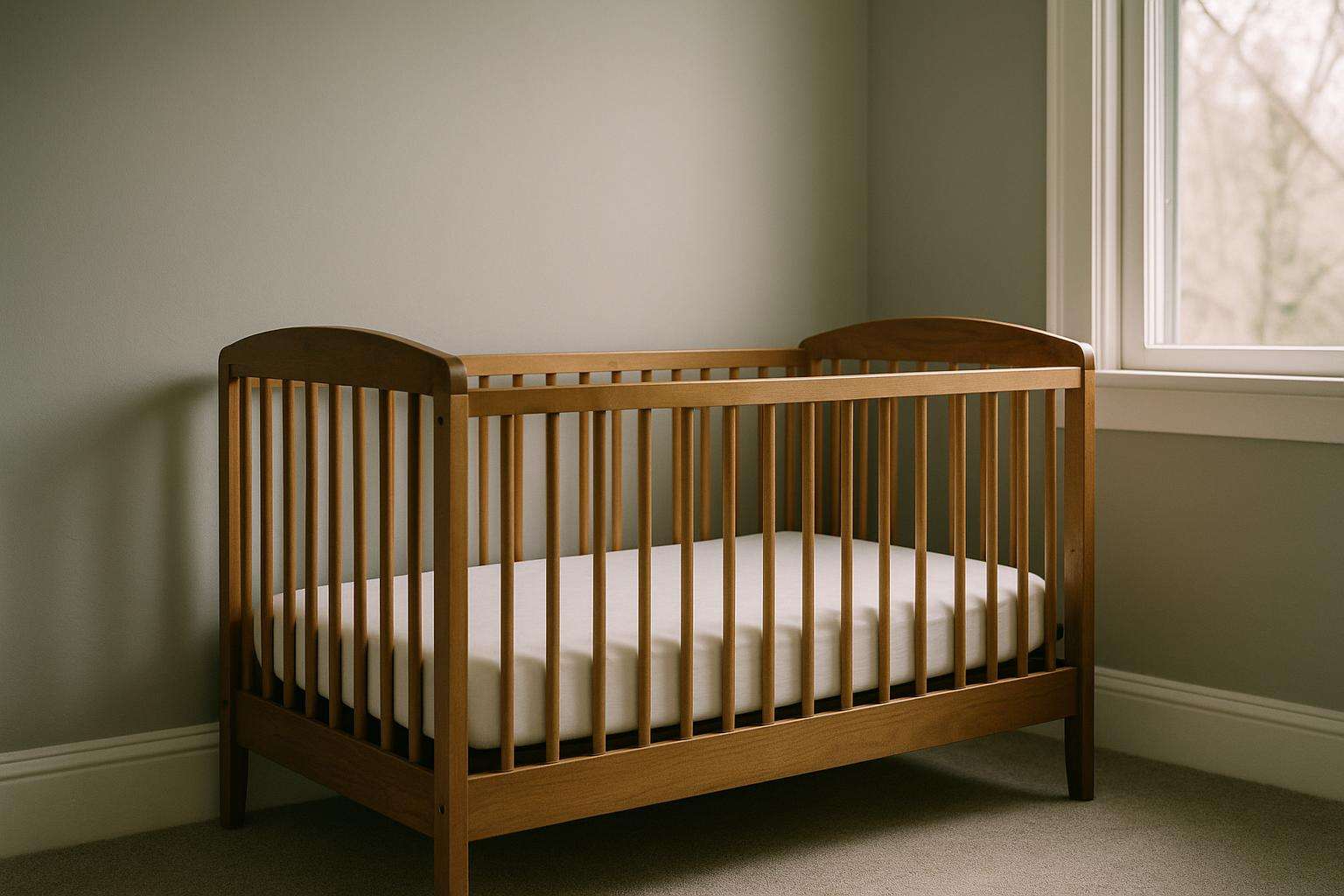
Every crib sold or resold in the United States must meet CPSC mandatory standards. Drop-side rails have been banned since 2011. Slats must be no wider than 2-3/8 inches. Before placing a baby in any secondhand crib, run a six-point checklist: no recall, no drop-side, correct slat spacing, sound hardware, snug mattress fit, and post-2011 labeling.
Federal crib safety law in the United States is governed primarily by the Consumer Product Safety Commission (CPSC) and codified through mandatory standards that reference ASTM International test methods. These regulations apply to all cribs manufactured, sold, or resold in the country — including those offered at childcare facilities, hotels, and motels. Understanding what the rules require is the first step toward a confidently safe nursery, whether you are buying new or inheriting a crib from a well-meaning relative.
This article is general information, not medical or safety advice specific to your situation. If you have concerns about your baby's sleep environment, consult your pediatrician or a certified child passenger safety technician.
What Did the 2011 Drop-Side Ban Actually Change?
The most consequential shift in modern crib safety was the 2011 CPSC ban on drop-side crib rails, effective June 28, 2011, under mandatory standard 16 CFR 1219. Before this date, drop-side designs — in which one or both side rails could be lowered to make it easier to reach a sleeping infant — were among the most popular crib types on the market. The problem: the hardware connecting the movable rail to the fixed frame was a chronic failure point.
Between 2000 and 2009, the CPSC documented at least 32 infant and toddler deaths attributed to drop-side rail failures, with hundreds of additional reported injury incidents involving entrapment and strangulation. In the 18 months leading up to the ban, the CPSC issued 11 recalls covering more than 7 million drop-side cribs from manufacturers including Graco, Stork Craft, Simplicity, Delta Enterprise, and Dorel. By 2011, total recalls of dangerous cribs exceeded 11 million units.
The 2011 regulation went beyond simply banning the drop-side mechanism. It also mandated:
- Stronger mattress support structures resistant to repeated loading
- More durable hardware — specifically, hardware that could not be assembled incorrectly in a way that would create a hazard
- More rigorous independent laboratory testing protocols before any crib could be sold
Every crib manufactured after June 28, 2011, must carry labeling confirming compliance with 16 CFR 1219 (full-size) or 16 CFR 1220 (non-full-size). That date stamp on the label is the single most important piece of information when evaluating any secondhand crib.
What Are the Current Mandatory Structural Rules for Cribs?
Beyond the drop-side ban, CPSC mandatory standards specify several structural requirements that every compliant crib must meet.
Slat Spacing
The maximum legal slat spacing is 2-3/8 inches (approximately 6 centimeters). This limit exists to prevent an infant's body or head from passing between or becoming wedged in the slats — a leading mechanism of entrapment in older and noncompliant cribs. A quick field test: a standard 12-oz aluminum soda can is approximately 2-5/8 inches in diameter. If it slides through a gap with room to spare, the spacing exceeds the legal limit.
Corner Post Height
Corner posts must be either flush with the top of the end panels or taller than 16 inches (41 cm). Any intermediate height creates a strangulation hazard: clothing, cords, or fabric can catch on a mid-height post and trap an infant's neck. According to Nemours KidsHealth, this is one of the most frequently overlooked structural hazards on older cribs.
Lead-Based Paint
Cribs manufactured before 1978 may contain lead-based paint. The CPSC advises that no crib from before 1978 should ever be used, regardless of its apparent physical condition. Lead paint can chip or be abraded by chewing — a behavior that commonly develops during teething — and lead exposure has no established safe level in infants.
Hardware Integrity
All hardware — bolts, screws, brackets, and locking mechanisms — must be present, tight, and fully functional. Repeated disassembly and reassembly (as commonly happens with inherited cribs) wears threaded hardware and can compromise structural integrity in ways that are difficult to detect visually.
What Changed in the 2026 Crib Mattress Standards?
Crib mattress safety is governed by a separate but parallel regulatory track. Every crib mattress sold in the United States must meet mandatory firmness standards currently referencing ASTM F2933. Two important 2026 updates brought this standard current.
In February 2026, the CPSC issued a direct final rule incorporating the revised ASTM F2933-25 standard (published October 2025) as mandatory, effective May 3, 2026. The updated standard strengthens five core mattress tests: firmness, impact durability, corner gap prevention, proper fitted-sheet fit, and — for innerspring models — coil compression.
A separate direct final rule adds new labeling requirements to full-size baby cribs effective August 1, 2026. This includes a warning printed on the inside of each top rail instructing caregivers never to leave an infant with sides down. According to SGS USA's compliance newsletter, this label requirement applies to all new full-size cribs entering the market after the effective date.
For parents choosing a crib mattress: any mattress purchased after May 3, 2026, must meet the updated ASTM F2933-25 standard. Look for a label on the mattress itself confirming compliance, in addition to any third-party certifications such as GREENGUARD Gold.
No matter which mattress you choose, it must fit snugly in the crib frame. The maximum allowable gap between any mattress edge and the adjacent crib rail is two fingers — approximately one inch. A wider gap creates a wedging or suffocation hazard. If a mattress moves freely within the crib, it is the wrong size for that frame.
Crib Bumpers and the Safe Sleep for Babies Act
Crib bumpers are no longer legal to sell anywhere in the United States. President Biden signed the Safe Sleep for Babies Act of 2021 into law, banning crib bumpers and inclined infant sleepers effective November 12, 2022. The CPSC codified the ban in a final rule published August 2023. Crib bumpers — including padded bumpers, vinyl bumper guards, and vertical slat covers — had been linked to at least 107 infant deaths between 1990 and 2016.
Inclined sleepers with a sleeping surface angle greater than 10 degrees are also banned under the same act. This category included the Fisher-Price Rock 'n Play Sleeper, which was voluntarily recalled in 2019 after being linked to more than 30 deaths. If a secondhand crib setup comes with bumpers or an inclined insert, remove and discard both before the crib is used — their presence disqualifies the setup regardless of the crib's structural condition.
How to Vet a Secondhand Crib: A Six-Point Checklist
The CPSC recommends against using any crib older than 10 years and advises buying new when possible. If you are evaluating a hand-me-down, work through this checklist in order — stopping immediately if any step fails.
| Check | What to Look For | Pass / Fail Threshold |
|---|---|---|
| 1. Recall status | Locate the manufacturer label — model number and manufacture date are printed on it. Search the CPSC recall database by model number. | Fail if recalled, if no label is present, or if manufacture date predates June 28, 2011 |
| 2. Drop-side check | Inspect both long side rails. Are they fixed and stationary, or is there a release mechanism allowing the rail to drop or slide? | Fail if any drop-side mechanism exists — even one that appears stuck or disabled |
| 3. Slat spacing | Attempt to slide a standard 12-oz soda can (approximately 2-5/8 inches diameter) through each gap between slats. | Fail if the can passes through without force; gap exceeds 2-3/8 inch maximum |
| 4. Hardware integrity | Check every bolt, screw, bracket, and locking pin. Shake the crib gently. Look for missing components, cracks in wood near joints, or any wobble. | Fail if any hardware is missing, broken, or cannot be sourced from the manufacturer |
| 5. Mattress fit | Place the mattress in the crib frame. Run a finger around all four edges between mattress and frame. | Fail if any gap exceeds approximately one inch (two fingers) — replace the mattress with a correctly sized one |
| 6. Compliance labeling | Confirm the label references 16 CFR 1219 (full-size) or 16 CFR 1220 (non-full-size) — the mandatory post-2011 standards. | Fail if no compliance reference is visible on the label |
A secondhand mattress should be replaced even when the frame passes all six checks. Mattress firmness degrades with use, increasing suffocation risk. Used mattresses can also harbor mold, bacteria, and accumulated chemical contaminants — including flame retardant residues and phthalate plasticizers that migrate out of foam over time and concentrate in dust at mattress-surface level, where an infant's nose and mouth are positioned during sleep.
A Note on Crib Certifications and Material Safety
All four major crib brands commonly recommended by gear editors — Babyletto, DaVinci, Pottery Barn Kids, and Delta Children — manufacture post-2011 compliant cribs. Delta Children is the only major brand holding both GREENGUARD Gold and JPMA (Juvenile Products Manufacturers Association) certification simultaneously; JPMA requires independent annual third-party laboratory testing verified against ASTM and CPSC standards.
GREENGUARD Gold certification, held by Babyletto, DaVinci, and Pottery Barn Kids as well, tests against more than 15,000 chemical emissions standards and is the most relevant indicator that a crib's finish has been independently verified for low VOC off-gassing. For families interested in minimizing chemical exposure during the critical newborn developmental window, solid wood construction (such as the New Zealand pine used by Babyletto and DaVinci) is preferable to composite or engineered wood products, which can off-gas formaldehyde from the adhesive binders in particleboard and MDF. Assembling nursery furniture and ventilating the room with open windows for four to six weeks before the baby's arrival allows the heaviest off-gassing period to pass before the infant occupies the space.
Whatever crib you choose — new or carefully vetted secondhand — the safety fundamentals remain the same: firm, flat mattress; fitted sheet only; no bumpers, pillows, positioners, or loose bedding. These basics, grounded in AAP safe-sleep guidelines, do more to protect your baby than any premium feature or certification tier.
Frequently asked
Are drop-side cribs legal to use in the United States?
No. The CPSC finalized a ban on drop-side cribs effective June 28, 2011, under mandatory standard 16 CFR 1219. The ban followed documentation of at least 32 infant and toddler deaths from 2000 to 2009 linked to drop-side rail failures, plus hundreds of additional injury reports. More than 11 million drop-side cribs were recalled between 2007 and 2011. The regulation prohibits manufacturing, selling, or reselling drop-side cribs — including in childcare facilities, hotels, and motels. If a hand-me-down crib has a drop-side mechanism of any kind, it must not be used regardless of its apparent condition. This is a hard rule with no exceptions.
How wide can crib slats legally be?
Federal mandatory standards require that crib slats be spaced no more than 2-3/8 inches (approximately 6 centimeters) apart, as specified by the CPSC crib safety rules. This limit prevents infants from getting their bodies or heads caught between the slats — the leading mechanism of entrapment injury in older cribs. You can check spacing quickly with a standard soda can: if the can slides through a gap without resistance, the spacing exceeds the legal limit and the crib should not be used. Corner posts are also regulated: they must be either flush with the top rails or taller than 16 inches to eliminate the strangulation hazard posed by clothing catching on mid-height protrusions. These checks take about two minutes and are worth doing on every crib before first use.
What changed in the 2026 crib mattress safety standard?
Two significant regulatory updates took effect in 2026. First, the CPSC issued a direct final rule in February 2026 incorporating the revised ASTM F2933-25 voluntary standard (published October 2025) as a mandatory requirement, effective May 3, 2026. That update strengthened the five core mattress tests: firmness, impact durability, corner gap prevention, fitted-sheet fit, and coil compression for innerspring models. Second, a separate direct final rule adds new warning label requirements to full-size cribs effective August 1, 2026, including a caution printed on the inside of the top rail instructing caregivers never to leave an infant with sides down. Any crib mattress purchased after May 2026 must meet the updated standard; older mattresses may not. Always confirm the mattress manufacture date on the product label.
Is it safe to use a secondhand crib mattress?
Most pediatric safety guidance recommends replacing the mattress when reusing a secondhand crib frame. Crib mattress firmness degrades with use — a softer surface raises suffocation risk — and used mattresses can harbor mold, bacteria, and accumulated chemical contaminants. A 2025 University of Toronto study published in Environmental Science & Technology found that body heat from a sleeping child significantly increased chemical emissions from mattress materials, including phthalate plasticizers and organophosphate flame retardants. Consumer Reports also advises against secondhand mattresses for these reasons. A new crib mattress meeting current ASTM F2933-25 standards typically costs $100–$300 for a certified model; it is one of the higher-value safety investments in the nursery, particularly given the 12–14 daily hours an infant spends on that surface.
What is the CPSC's recommendation on using older cribs?
The CPSC recommends against using any crib older than 10 years and advises buying new whenever possible. This guidance reflects the fact that older cribs — especially those made before the 2011 mandatory standard took effect — may have been assembled and disassembled multiple times, degrading the structural integrity of the hardware. Cribs manufactured before 1978 carry an additional risk: they may contain lead-based paint and should never be used regardless of structural condition. If you are evaluating an older crib, look for a manufacturer's label showing the production date and model number. The CPSC recall database can be searched by model number to verify whether the specific unit was ever subject to a recall. No label means no verification — and the crib should be passed over. When in doubt, a new crib is the safer choice.
Are crib bumpers still sold legally in the United States?
No. Crib bumpers of all types — padded, vinyl-coated, and braided — were federally banned when President Biden signed the Safe Sleep for Babies Act of 2021, effective November 12, 2022. The CPSC codified the ban in a final rule published in August 2023. Between 1990 and 2016, crib bumpers were linked to at least 107 infant deaths. Inclined infant sleepers with a sleeping surface angled greater than 10 degrees — including the Fisher-Price Rock 'n Play Sleeper — were banned under the same law. If a secondhand crib setup includes bumpers, remove and discard them before the crib is used; their inclusion is a safety disqualifier. The same applies to any inclined sleep attachment positioned inside or adjacent to the crib.