Baby Gear
Safe-Sleep Nursery Setup: What Goes in the Crib (AAP Guidelines)
The AAP's 'bare is best' rule explained — from what belongs in the crib to the products that are now federally banned, with room-sharing guidance and the environmental toxin checklist new parents actually need.
Clinically reviewed · June 2026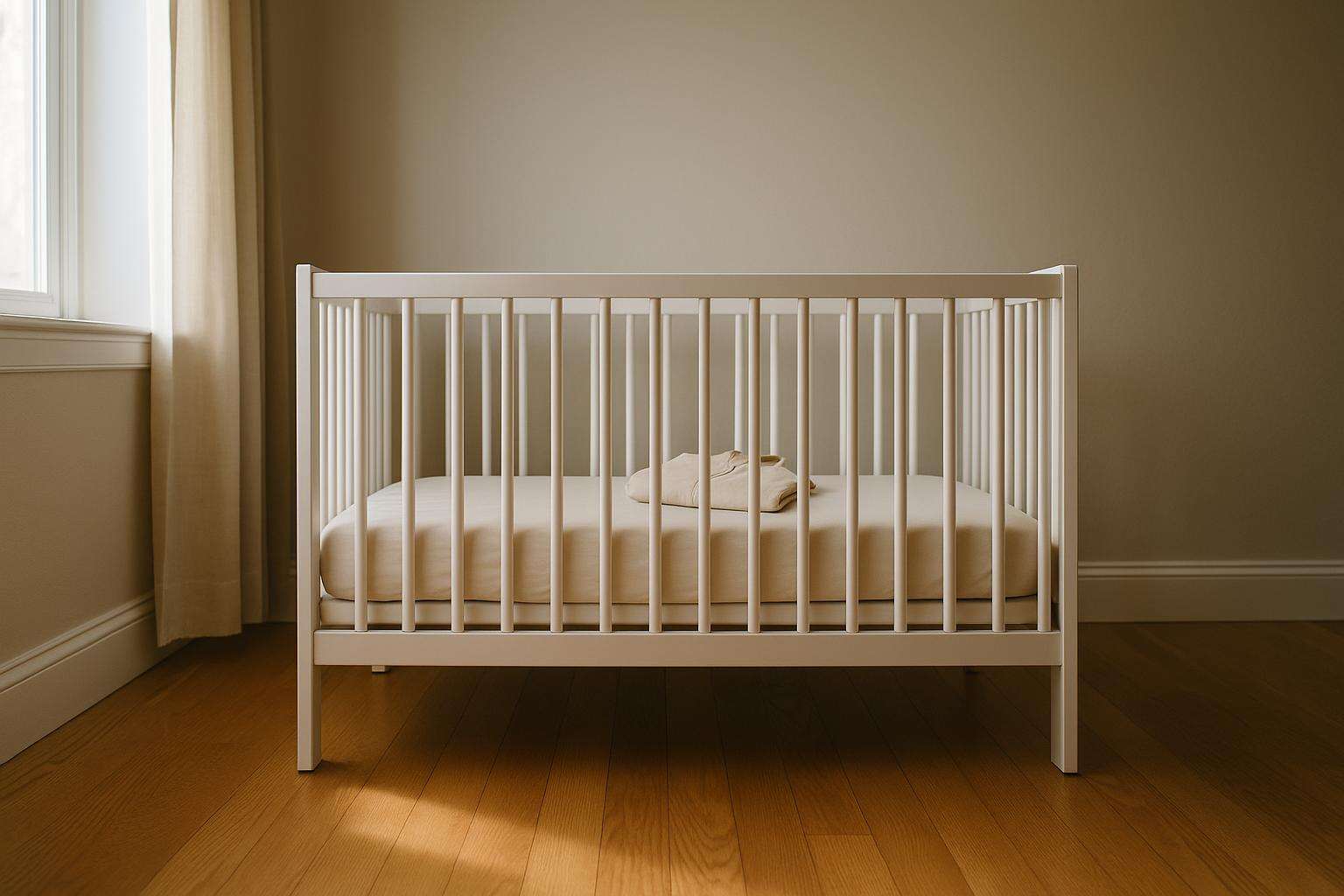
The AAP's 2022 safe-sleep guidelines are clear: the crib should contain only your baby and a firm, flat mattress with one fitted sheet. No bumpers (now federally banned), no loose blankets, no inclined sleepers, no weighted swaddles — and your baby should sleep on their back, in your room, for at least the first six months.
Approximately 3,500 infants die each year in the United States from sleep-related causes — sudden infant death syndrome (SIDS), accidental suffocation, and strangulation in the sleep environment. That number has not moved meaningfully in recent years despite decades of public health messaging, partly because the nursery product market continues to introduce items that look reassuring but have not been clinically validated and, in some cases, carry documented risks.
The American Academy of Pediatrics published updated safe-sleep guidelines in 2022 — the most comprehensive revision since 2016 — and they remain the clinical standard in 2026. This guide walks through what those guidelines actually say, which products are now banned by federal law, and what the nursery environment itself should look like.
This article is general health education, not medical advice. Discuss your baby's specific sleep setup and any clinical concerns with your pediatrician or midwife.
What Does 'Bare Is Best' Actually Mean?
The AAP phrase "bare is best" refers to the sleep surface, not the baby. It means the crib interior should be stripped of everything except the mattress and its fitted sheet. The complete list of what belongs in the crib is short:
- Your infant
- A firm, flat mattress meeting CPSC mandatory standards (ASTM F2933)
- A single fitted sheet sized specifically for that mattress — snug on all sides with no gap greater than two fingers between mattress edge and crib frame
That is the entire list. The 2022 guidelines are explicit that a firm and flat sleep surface is non-negotiable. "Firm" means the mattress does not conform to the shape of the infant's head or body when pressure is applied. "Flat" means the sleeping surface angle is less than 10 degrees — a new threshold added in the 2022 revision that specifically addresses the category of marketed inclined sleepers.
For warmth, dress your baby in a wearable blanket (sleep sack) or appropriate sleep clothing layers rather than placing any loose blanket in the crib. A sleep sack cannot migrate over a baby's face the way a loose blanket can. HALO SleepSack is the most widely recommended brand and comes in a range of tog ratings for different room temperatures; the AAP does not endorse any specific brand, but wearable blankets as a category are explicitly supported by the guidelines.
Every sleep — including naps, not only overnight — should begin with the infant placed on their back (supine position). Side sleeping is not considered safe. Once an infant can roll independently, which typically happens between four and six months, it is acceptable to allow them to find their own position after being placed on their back.
Which Products Are Now Federally Banned?
Several product categories that were widely sold — and in some cases continue to appear in secondhand markets — are now illegal to manufacture, distribute, import, or sell in the United States.
Crib bumpers. All crib bumpers, including padded bumpers, vinyl bumper guards, and braided bumper alternatives, have been banned since November 12, 2022 under the Safe Sleep for Babies Act. The CPSC codified this in a final regulation published August 2023. The ban followed documentation of at least 107 infant deaths linked to bumpers between 1990 and 2016. If bumpers come with secondhand nursery furniture or are offered as gifts, they should not be used.
Inclined infant sleepers. Any product with a sleeping surface angle greater than 10 degrees is banned under the same act. This category includes the Fisher-Price Rock 'n Play Sleeper, which was voluntarily recalled in 2019 after being linked to more than 30 deaths, and similar products from other manufacturers. The 10-degree limit applies regardless of marketing language — if a product markets itself as a sleeper but sits at an angle, it does not comply.
Beyond the legal bans, the AAP specifically recommends against:
- Weighted swaddles and weighted sleep sacks — the added weight can restrict chest movement and interfere with a baby's ability to breathe against an obstruction
- Car seats, swings, bouncers, and loungers as sleep surfaces — these are not designed or tested for sustained unmonitored sleep, particularly for infants under four months whose neck muscles cannot maintain a safe airway angle
- Home cardiorespiratory monitors or pulse oximetry devices marketed for SIDS prevention — no published clinical evidence supports their effectiveness at reducing SIDS risk, and the AAP cautions they can create false reassurance
| Product | Status | Why |
|---|---|---|
| Firm flat crib mattress + fitted sheet | Required | The only safe sleep surface per AAP |
| Wearable blanket / sleep sack | Recommended for warmth | Cannot migrate over baby's face |
| Pacifier at sleep time | Endorsed by AAP | Associated with reduced SIDS risk |
| Crib bumpers (all types) | Federally banned (Nov 2022) | Linked to 107+ infant deaths 1990–2016 |
| Inclined sleepers (>10 degrees) | Federally banned (Nov 2022) | Linked to infant suffocation deaths |
| Weighted swaddles / sleep sacks | Avoid — AAP warning | Can restrict chest movement and breathing |
| Consumer smart socks / home monitors for SIDS prevention | Not recommended — AAP | No clinical evidence of effectiveness |
| Swings, bouncers, loungers as sleep surfaces | Avoid for sustained sleep | Not designed or tested for safe unmonitored sleep |
| Pillows, loose blankets, stuffed animals in crib | Remove entirely | Suffocation hazard |
How Long Should a Baby Room-Share — and Is Bed-Sharing Ever Safe?
The 2022 AAP guidelines revised the room-sharing recommendation from "ideally for the first year" (the 2016 guidance) to ideally for at least the first six months. This was a data-driven update, not a relaxation of caution. The evidence base shows that 90% of SIDS cases occur before an infant reaches six months of age, with the peak risk window concentrated between one and four months. The revision was intended to make the guideline more achievable for families — and to focus the emphasis on the period of highest risk — not to suggest that room-sharing after six months is unnecessary.
Room-sharing means placing the infant's separate sleep surface (a crib, bassinet, or play yard) in the parents' bedroom close to the parents' bed. This arrangement is associated with a reduction in SIDS risk of as much as 50% compared to an infant sleeping in a separate room from birth.
Bed-sharing — the infant sleeping on the same mattress, sofa, or armchair as an adult — is not recommended under any circumstances. The risk of sleep-related infant death from bed-sharing on a couch or soft armchair is up to 67 times higher than sleeping on a firm, separate surface. Bed-sharing with an infant under four months carries five to ten times the risk of room-sharing, and that risk increases further when a caregiver has consumed alcohol, cannabis, or sedating medications — including some antihistamines and prescription sleep aids.
If you are finding it difficult to maintain a safe sleep setup during night feeds — a reality many families face — speak with your midwife or pediatrician about strategies. The AAP's guidance is designed to reduce risk, not to judge the practical realities of exhausted new parents.
Does the Nursery Environment Itself Matter for Safe Sleep?
The structural AAP guidelines focus on the sleep surface and room-sharing arrangement. But the broader nursery environment — particularly its chemical composition — is worth understanding for parents who want to minimize their newborn's total exposure during a critical developmental window.
Infants spend 12 to 14 hours daily with their faces inches above the mattress surface. Research published in April 2025 in Environmental Science & Technology — led by Professor Miriam Diamond at the University of Toronto — tested 25 children's bedrooms and 16 newly purchased mattresses and detected more than two dozen harmful compounds including phthalate plasticizers, organophosphate ester flame retardants, and UV-filter chemicals. Critically, when researchers simulated a child's body temperature on the mattresses, chemical emissions increased "as much as by several times." The Environmental Working Group has documented that flame retardant metabolites were detectable in the urine of all 43 infants in one study, with children showing higher levels than their mothers — reflecting their greater time on and near foam products.
This does not mean every conventional nursery is a crisis. It means that where parents have a choice, certifications matter. For crib mattresses, the certification hierarchy that best addresses chemical exposure runs: GOTS + GOLS (Naturepedic and similar certified-organic brands) > EWG VERIFIED > MADE SAFE > GREENGUARD Gold (a useful floor, but it does not restrict flame retardants, PFAS, or phthalates specifically). Consumer Reports, in a review conducted in partnership with MADE SAFE, recommends avoiding mattresses containing polyurethane foam, added flame retardants, PFAS, and vinyl.
Practical steps to reduce nursery chemical burden:
- Assemble nursery furniture four to six weeks before the due date and ventilate the room with open windows to allow the heaviest off-gassing period to pass before the baby arrives
- Run a HEPA air purifier with activated carbon filtration continuously — HEPA captures fine particulate matter including chemical-laden dust; activated carbon adsorbs VOCs and gaseous emissions that HEPA alone cannot remove
- Use low-VOC or zero-VOC paint on nursery walls
- Vacuum regularly with a HEPA-filtered vacuum to reduce flame retardant and phthalate-laden dust on floors and soft surfaces
- Wash all new nursery textiles before first use to remove residual manufacturing chemicals
- Secure all window blind and curtain cords so they are inaccessible from the crib — cord entanglement is a strangulation hazard independent of crib design
Maintain a room temperature of 68–72°F (20–22°C) and a fully smoke-free household environment. Secondhand smoke is a well-documented independent risk factor for SIDS — this includes smoke that has settled into furniture, clothing, and surfaces even when a caregiver is not actively smoking in the room.
Setting up a safe sleep nursery is one of the most concrete things you can do before a baby arrives. The rules are not complicated: firm, flat, bare surface; baby on their back; baby in your room for at least the first six months; nothing in the crib that is not the baby and a fitted sheet. Everything else is a layer of additional care — choosing certified mattresses and ventilating the room are meaningful steps, not anxiety-driven overreach. Start with the AAP fundamentals and build from there.
Frequently asked
What exactly does the AAP say should go in the crib?
The American Academy of Pediatrics is specific: the only items that belong in the crib are the infant and a firm, flat mattress covered by a single fitted sheet sized for that exact mattress. Nothing else. No pillows, loose blankets, quilts, comforters, sheepskins, stuffed animals, wedges, or sleep positioners. For warmth, the AAP recommends dressing the baby in a wearable blanket (sleep sack) or appropriate sleep clothing rather than adding loose bedding that could cover the baby's face. The 2022 guidelines also explicitly state that any inclined sleep surface greater than 10 degrees is unsafe, regardless of whether the product carries a sleep-marketing claim. This information is general education — always discuss your baby's specific sleep setup with your pediatrician.
Are crib bumpers still legal to buy?
No. Crib bumpers of all types — padded, vinyl-coated, and braided rope styles — are federally banned in the United States. President Biden signed the Safe Sleep for Babies Act into law, and the ban took effect November 12, 2022. The Consumer Product Safety Commission codified the rule in a final regulation published August 2023. The ban covers manufacture, distribution, importation, and retail sale. Bumpers had been linked to at least 107 infant deaths between 1990 and 2016. If you find bumpers at a secondhand sale or receive them as a hand-me-down, they should not be used. The ban also covers inclined infant sleepers with a sleeping surface angle greater than 10 degrees — a category that includes the recalled Fisher-Price Rock 'n Play.
How long should a baby room-share, and is bed-sharing ever safe?
The AAP's 2022 update refined its room-sharing guidance to at least the first six months, revised from the previous recommendation of ideally the first year. The reason is data-driven: 90% of SIDS cases occur before six months of age, with the peak risk window between one and four months. Room-sharing — placing the baby's separate sleep surface close to the parents' bed in the same room — is associated with up to a 50% reduction in SIDS risk compared to a separate room. Bed-sharing is not recommended under any circumstances. The risk of sleep-related infant death on a couch or soft armchair is up to 67 times higher than a firm, separate surface. Bed-sharing with an infant under four months carries five to ten times the risk of room-sharing alone, and that risk increases further when a caregiver has consumed alcohol or sedating medication.
Are weighted swaddles and smart socks safe for newborns?
Weighted swaddles and weighted sleep sacks are specifically identified by the AAP as products to avoid: the added weight can restrict chest movement and interfere with a baby's breathing effort. No weighted garment should be placed on or near a sleeping infant. Home cardiorespiratory monitors and pulse oximetry devices marketed for SIDS prevention — including some consumer-grade 'smart sock' products — are also flagged by the AAP. As of 2025, no published clinical evidence supports their effectiveness at reducing SIDS risk, and the AAP cautions that they may create false reassurance that could lead caregivers to relax other safe-sleep practices. Swings, bouncers, and infant loungers are not designed or tested for sustained unmonitored sleep and should not be used as a regular sleep surface, particularly for infants under four months.
Do pacifiers help reduce SIDS risk?
Yes — the AAP endorses pacifier use at nap and bedtime because it is associated with a statistically significant reduction in SIDS risk. The pacifier does not need to be reinserted if it falls out once the baby is asleep. For breastfed infants, the AAP recommends introducing the pacifier after breastfeeding is well established, typically around three to four weeks, to avoid nipple confusion during the critical early feeding period. There is no consensus on the mechanism by which pacifier use lowers risk, though current hypotheses involve effects on arousal thresholds and airway positioning. Use a one-piece pacifier sized for newborns, and do not attach it to the baby or the crib with a cord or clip. See HealthyChildren.org for the full AAP guidance on pacifier use and safe sleep.
What room temperature, air quality, and toxin precautions matter most for the nursery?
The AAP recommends a room temperature of 68–72°F (20–22°C) and a fully smoke-free environment — secondhand smoke is a well-documented independent SIDS risk factor. Beyond temperature and smoke, functional medicine experts highlight the nursery's chemical environment as a meaningful modifiable factor. Infants spend 12–14 hours daily within inches of the mattress surface, where VOC concentrations can be roughly double those at standing height. Practical steps: assemble nursery furniture four to six weeks before the due date and ventilate with open windows to allow off-gassing to peak and dissipate; run a HEPA air purifier with activated carbon filtration continuously; vacuum regularly with a HEPA-filtered vacuum; wash all new textiles before first use. Choose mattresses certified to GOTS, GOLS, or EWG VERIFIED standards to minimize flame retardant, PFAS, and phthalate exposure. Consult a qualified practitioner for guidance specific to your situation.