Baby Gear
Travel Systems Explained: Which Car Seats Fit Which Strollers
A CPST's plain-language guide to native connections, adapter compatibility, and bundle-pricing math for the four biggest stroller families—UPPAbaby, Nuna, Bugaboo, and Baby Jogger.
Clinically reviewed · June 2026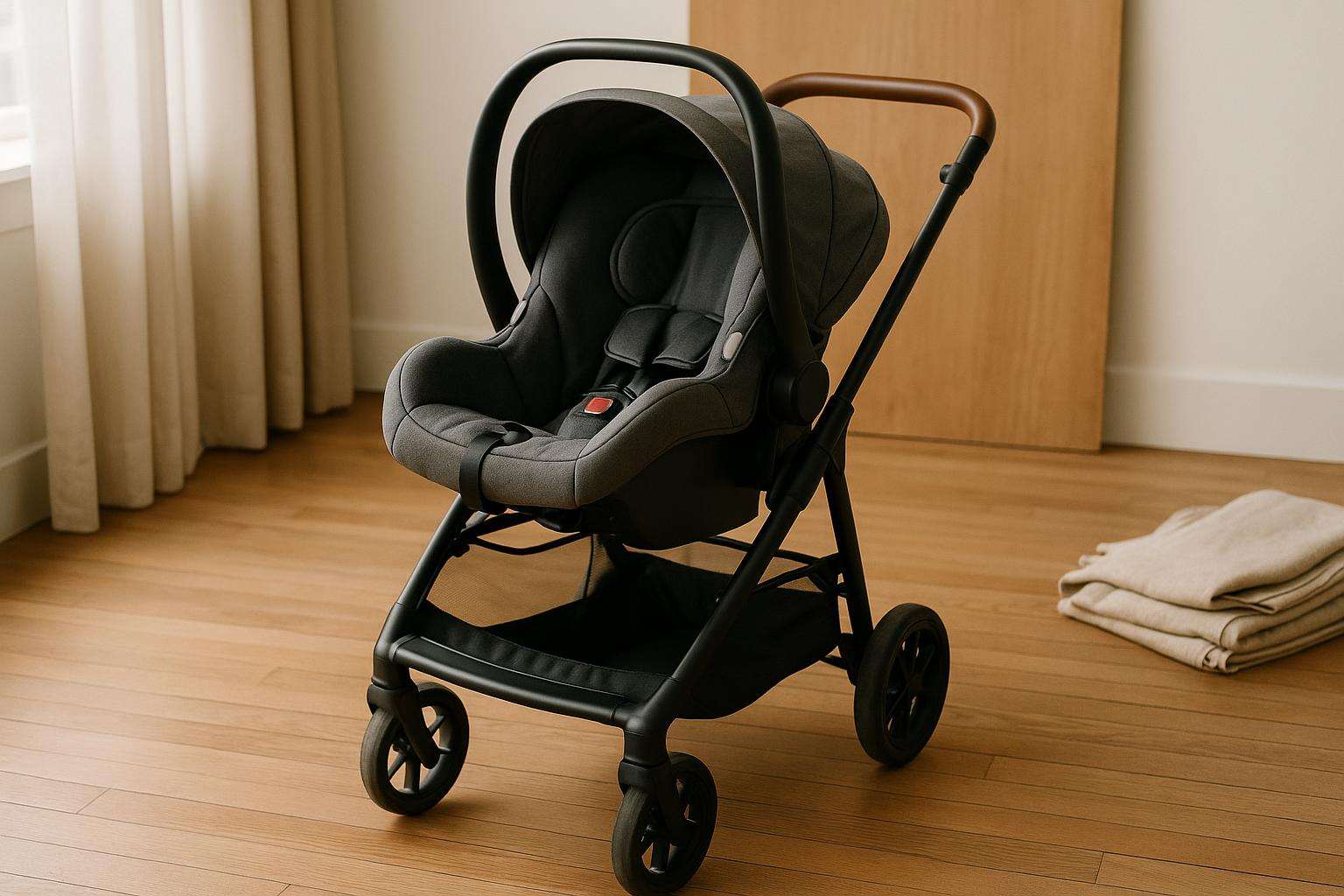
Only infant carriers (bucket seats) snap into strollers — convertibles and all-in-ones cannot. Whether you need an adapter depends on the brand pairing: UPPAbaby MESA clicks into Vista/Cruz with no adapter; Nuna PIPA clicks into the DEMI Next natively; most other cross-brand pairings need a $49–$75 adapter sold by the stroller brand.
A travel system is one of the most practical decisions you'll make before your baby arrives — and one of the most misunderstood. Parents routinely discover after buying a stroller that their infant car seat requires an adapter, or worse, that the combination isn't approved at all. As a certified child passenger safety technician (CPST), I've walked dozens of families through this process. Here is what you actually need to know.
What exactly is a travel system, and what are its limits?
A travel system is the combination of an infant carrier (the removable bucket seat that stays rear-facing) and a stroller frame designed to accept it. The idea is simple and genuinely useful for new parents: you move the carrier from the car base to the stroller without unstrapping or waking your newborn. That single click is the entire value proposition.
The most important thing to understand about travel systems is their scope: only infant carriers are compatible with stroller frames. Convertible all-in-one seats, forward-facing-only seats, and booster seats cannot be adapted for stroller use, regardless of price point. Babylist's compatibility guide explains this foundational rule clearly — an unapproved connection carries real crash-safety risk even if the seat appears to lock in place.
The second limit is lifespan. Infant carriers support babies from roughly 4 lbs to 30–35 lbs, and most infants outgrow their carrier somewhere between 12 and 30 months. After that, the carrier is retired. The stroller continues as a standalone pushchair. Families should go into this purchase knowing they're buying a setup that works brilliantly for the first year or two, and then transitions.
Which strollers accept which car seats — and what does it cost?
Compatibility breaks down into three tiers: native (no adapter needed), adapter-required (approved cross-brand), and not compatible. Here is how the four major stroller families in 2025 map out:
| Stroller | Native (No Adapter) | Compatible With Adapter | Not Compatible | Adapter Cost |
|---|---|---|---|---|
| UPPAbaby Vista V2 / Cruz | UPPAbaby MESA, MESA V2, MESA V3, MESA Max | Nuna PIPA series, Chicco KeyFit 30/35, Maxi-Cosi, Cybex, Clek | Graco SnugRide (all versions) | $49–$60 per adapter |
| Nuna DEMI Next | Nuna PIPA, PIPA RX, PIPA urbn, PIPA aire, PIPA aire RX | Maxi-Cosi style seats via adapter | Check Nuna compatibility list | Varies; Nuna-sold adapters |
| Bugaboo Fox 5 Renew | Adapters included in box (Nuna PIPA RX, PIPA urbn, Cybex Aton G, Cybex Cloud G Lux, Clek Liing, Maxi-Cosi Mico Lux+) | See Bugaboo compatibility list for older Fox adapters | Not all seat models; verify by model | $0 (included) for Fox 5 Renew; ~$50–$75 for older Fox models |
| Baby Jogger City Select 2 | None (all connections via adapter) | Baby Jogger, Britax, Chicco, Graco, Nuna, UPPAbaby | Brands not listed on official chart | $49–$60 per adapter |
| Graco strollers | Graco SnugRide, SnugRide Click Connect, SnugFit (verified models) | Limited; check Graco compatibility chart | Most premium brands (UPPAbaby, Nuna, Bugaboo) | $0 for same-brand |
| Chicco strollers | Chicco KeyFit 30, KeyFit 35, Fit2, Fit2 Air | Select models via adapter (see Strolleria list) | Varies by stroller model | $0 for same-brand |
A few things stand out in this table. First, the Baby Jogger City Select 2 has the broadest cross-brand compatibility — it accepts seats from six major brands with the appropriate adapter, and Baby Jogger publishes a downloadable compatibility chart so you can verify your exact seat model before buying. Second, the UPPAbaby Vista V2's native connection to the MESA is its clearest competitive advantage in the travel system space. Third, the Bugaboo Fox 5 Renew's decision to include car seat adapters in the box eliminates what was previously a separate $50–$75 purchase — a meaningful shift for buyers.
Always verify compatibility using the stroller brand's official, current compatibility chart — not a retailer's third-party list. Manufacturers update approved pairings as new car seat models are released, and a combination that worked with last year's seat version may not be approved for the current one.
How does bundle pricing compare to buying separately?
Travel system bundles — a stroller plus an infant car seat sold together — typically carry a 10–15% discount compared to purchasing each component separately, though exact savings vary by retailer and promotional period. The math is most transparent in the premium tier.
Consider the Nuna DEMI Next with PIPA RX: at retail, the DEMI Next stroller alone is approximately $949.95, and the PIPA RX infant seat runs approximately $550. That is $1,499.95 à la carte. Nuna bundles pairing these two items fall in the $1,000–$1,500 range depending on configuration, meaning the savings can be meaningful — but not always guaranteed. Always compare the bundle price against the current street prices of the components individually.
For the UPPAbaby ecosystem, the Vista V2 retails at $999.99 (with bassinet included) and the MESA V3 at $399.99 — totaling $1,399.98 before any adapter cost, since MESA-to-Vista is native and free. UPPAbaby does offer bundle promotions at select retailers. The stroller also accepts the Nuna PIPA RX via the $49–$60 Nuna/Maxi-Cosi adapter, so parents who prefer the PIPA RX's superior crash-test score can still build an UPPAbaby stroller system.
At the budget tier, Graco's same-brand click-and-go travel systems deliver the sharpest bundle value. The Graco SnugRide 35 and a compatible Graco stroller can be found bundled for $250–$400, with zero adapter cost. The trade-off is that you cannot use a premium stroller with a Graco seat — UPPAbaby strollers explicitly do not support Graco seats, which is the most common compatibility gap families discover too late.
Resale value is part of the true-cost calculation for premium systems. UPPAbaby, Nuna, and Bugaboo gear commonly sells on secondary markets at 50–65% of original retail. A $1,400 UPPAbaby setup that resells for $750 has a real net cost closer to $650 — which shifts the premium-versus-budget math considerably. Graco gear holds less resale value by percentage.
What to check before you buy: a practical pre-purchase checklist
Before committing to a stroller and car seat combination, work through these five questions:
- Does my infant car seat appear on the stroller brand's official compatibility list? Use the manufacturer's own chart, not a retailer's suggestion. Verify by exact model name and year — a PIPA RX and a PIPA aire RX are different seats with potentially different adapter requirements.
- Is an adapter required, and who makes it? Use only adapters sold by the stroller manufacturer for that specific seat. Third-party adapters have not been crash-tested in combination with your stroller and seat.
- Does the bundle price beat the street price of each item separately? Do this math; bundles are not always cheaper once you account for current promotions on individual items.
- What happens after the infant carrier phase? Evaluate the stroller's toddler seat on its own merits — weight limit, recline, reversibility — since that's what you'll be using for years two through four.
- Have I registered both the car seat and the stroller? Registration ensures you receive recall notices. The NHTSA recall database at nhtsa.gov/recalls is the authoritative resource; check it before any used-gear purchase as well.
This article provides general product and safety information and is not a substitute for guidance from a certified child passenger safety technician. NHTSA's inspection station locator (nhtsa.gov) can connect you with a local CPST who will check your installation at no charge.
Frequently asked
Can any infant car seat click into any stroller?
No — only infant carriers (removable bucket seats) are designed to snap into stroller frames. Convertible all-in-one seats, forward-facing seats, and booster seats cannot be adapted for stroller use, regardless of brand or price. Even among infant carriers, compatibility depends on whether the stroller and seat are from the same brand or whether an approved adapter is available. Babylist's compatibility guide lays out the foundational rule clearly: always verify that the combination is explicitly manufacturer-approved before purchasing. Using an unapproved connection — even if the seat physically locks in — carries real safety risks in a crash. As a rule of thumb, stick to same-brand pairings or adapters sold by the stroller manufacturer for that specific car seat model.
Do I need an adapter to use a Nuna PIPA with an UPPAbaby stroller?
Yes, a brand-specific adapter is required. The UPPAbaby Vista and Cruz strollers accept the MESA, MESA V2, MESA V3, and MESA Max natively — no adapter needed. For the Nuna PIPA series (PIPA, PIPA RX, PIPA aire, PIPA aire RX), you need UPPAbaby's Maxi-Cosi/Nuna/Cybex/Clek adapter, which retails for approximately $49–$60 USD. The Chicco KeyFit family requires a separate, Chicco-specific UPPAbaby adapter. One important note: UPPAbaby confirms on its product page that its strollers are not compatible with Graco infant car seats at all — a meaningful gap given Graco's wide market share. Always verify the complete compatibility list before purchase so you aren't caught off-guard at the hospital.
What is a travel system and when does it stop being useful?
A travel system is the combination of an infant car seat and a stroller frame designed to work together — you lift the carrier from the car base and click it directly onto the stroller without waking the baby. It's the most common first-gear purchase for new parents. The limitation is lifespan: travel system use is restricted to infant carriers, which support babies from roughly 4 lbs up to 30–35 lbs (depending on the seat). Most infants outgrow their carrier between 12 and 30 months. After that, the seat is retired and the stroller continues as a standalone pushchair. Families who want a longer-term travel system effectively need a stroller with a good toddler seat, a carrier for the early months, and a plan for what comes next.
Is it cheaper to buy a travel system bundle or purchase separately?
Bundles typically offer a 10–15% discount compared to purchasing the stroller and car seat separately, though exact savings depend on the retailer and promotion. Nuna DEMI Next bundles pairing the stroller with a PIPA seat run approximately $1,000–$1,500 depending on configuration, versus $949.95 stroller-only plus $550 for the PIPA RX (roughly $1,500 à la carte). Budget-tier pairings like Graco's click-and-go SnugRide stroller systems deliver the sharpest bundle savings. Parenthood Adventures' 2025 comparison of premium systems notes that resale value matters too — UPPAbaby, Nuna, and Bugaboo gear commonly sells on secondary markets at 50–65% of original retail, which meaningfully offsets premium upfront spend. Always factor in the cost of any adapters needed when doing your own math.
Which stroller works with the most infant car seat brands?
The Baby Jogger City Select 2 has the broadest cross-brand infant car seat compatibility of any major stroller — it accepts seats from Baby Jogger, Britax, Chicco, Graco, Nuna, and UPPAbaby with the corresponding branded adapter. Baby Jogger publishes a downloadable compatibility chart at babyjogger.com that lists every approved combination. For parents who already own a car seat from any of those brands or want maximum flexibility, the City Select 2 is the most accommodating frame. The UPPAbaby Vista V2 is a strong second, supporting the MESA natively and Nuna, Chicco, Maxi-Cosi, Cybex, and Clek via adapters — but notably not Graco. If your priority is Graco compatibility, a Graco stroller is your best path to a no-adapter setup.
Does the Bugaboo Fox 5 include car seat adapters?
Yes — the Bugaboo Fox 5 and Fox 5 Renew (2025) include car seat adapters in the box, which is a meaningful value add compared to older Fox models where adapters were a separate purchase at approximately $50–$75 USD. The included adapters use a Maxi-Cosi style connection and are compatible with Nuna PIPA RX, Nuna PIPA urbn, Cybex Aton G, Cybex Cloud G Lux, Clek Liing, and Maxi-Cosi Mico Lux+. Bugaboo's product page lists the current approved seat models; parents should verify this list before purchasing a seat, as compatibility may not extend to newer seat versions released after the Fox 5 was manufactured. Buyers of the original Fox or Fox 2 must still purchase adapters separately.
Is a native (no-adapter) connection safer than using an adapter?
A properly used, manufacturer-approved adapter is considered as safe as a native connection — the key word being approved. An unapproved connection, even if the seat physically clips in, has not been crash-tested in that configuration and presents genuine risk. Manufacturer-sold adapters are designed and tested for the specific seat-stroller pairing they support. Babylist's safety guide puts it plainly: only use combinations the stroller manufacturer explicitly approves. Native connections — like the UPPAbaby MESA clicking directly onto the Vista — offer one practical advantage: fewer mechanical steps means fewer opportunities for an incomplete connection. If you use an adapter, always verify the click is fully seated before walking and check the connection each time you transfer the seat. Never improvise with a third-party adapter not sold or approved by the stroller manufacturer.