Birth & Postpartum
Natural Pain Relief in Labor: Nitrous, Water, TENS and Counterpressure
A midwife-reviewed guide to non-pharmacologic and semi-pharmacologic labor pain options—what the evidence says, who each method suits, and how to combine them.
Clinically reviewed · June 2026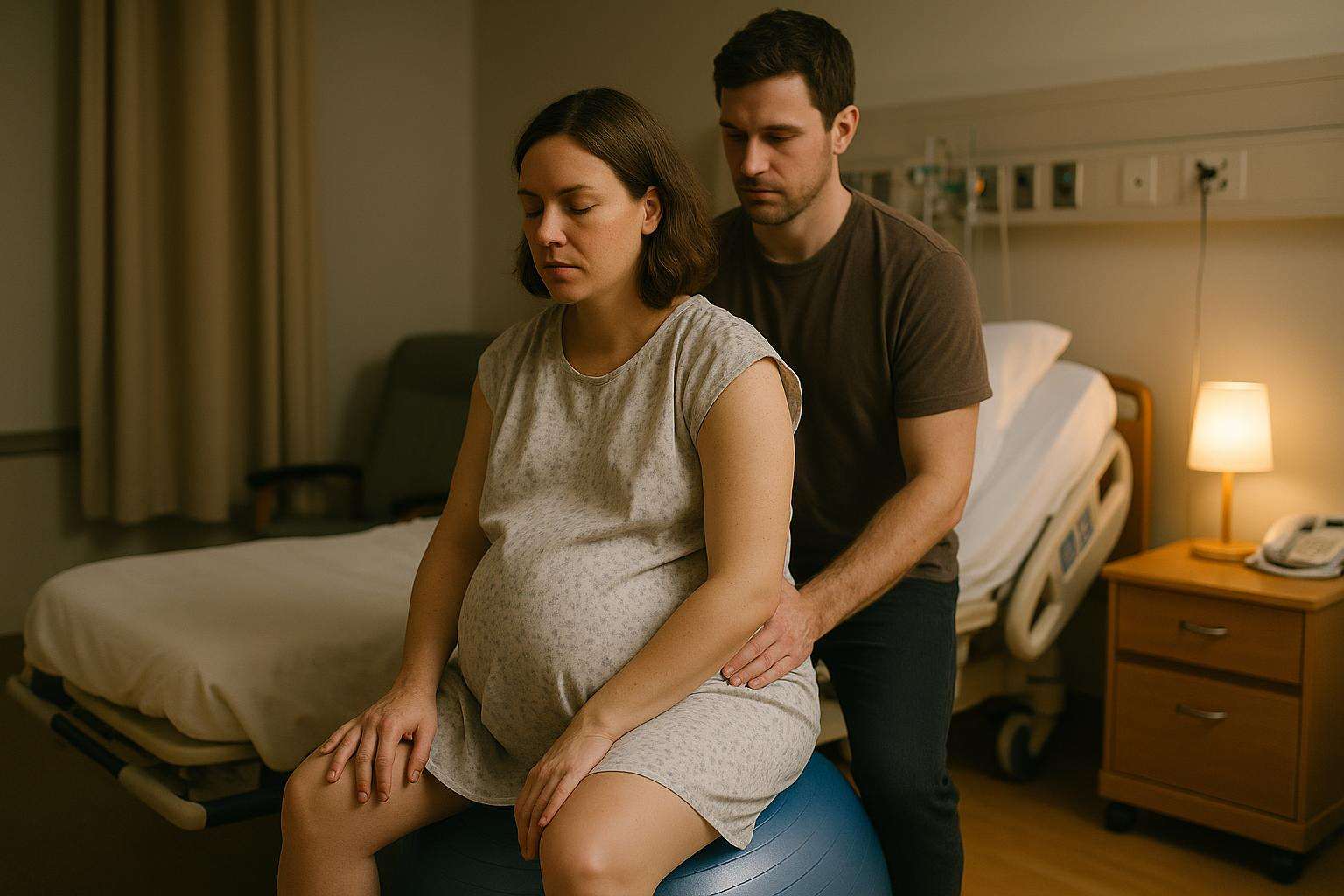
Non-pharmacologic labor pain relief works best as a layered toolkit: nitrous oxide manages perception and anxiety; hydrotherapy relaxes muscles; TENS competes with pain signals; a birth ball promotes fetal descent; counterpressure targets back labor. None matches an epidural for raw pain reduction, but together they can meaningfully shorten labor and reduce the need for pharmacologic intervention.
Choosing how to manage labor pain is one of the most personal decisions in birth preparation—and one that benefits from knowing what the evidence actually says before you’re in the thick of a contraction. Non-pharmacologic and semi-pharmacologic options have a stronger research base than they did a decade ago, and several have received updated endorsements from ACOG and the American College of Nurse-Midwives in 2024. This guide covers the four methods named most often by laboring women—nitrous oxide, hydrotherapy, TENS, and counterpressure—plus birth balls, acupressure, and mindfulness, with honest notes on what each can and cannot do.
This article provides general information only and is not a substitute for individualized medical advice. Talk with your midwife or obstetrician about which options are available at your birth setting and appropriate for your specific pregnancy.
How does nitrous oxide work for labor pain, and where can I get it?
Nitrous oxide—the same 50/50 nitrous-oxygen blend used in some dental offices—is self-administered through a handheld mask at the onset of each contraction. It does not eliminate pain but meaningfully alters your perception of it, producing mild analgesia and anxiolysis (reduction in anxiety) that many women describe as making contractions feel more distant or manageable. Onset is rapid, around 30–60 seconds, and the effect dissipates within minutes of lowering the mask. That reversibility is its defining advantage: you can start, pause, or stop at any point during labor without affecting your ability to transition to an epidural later.
A 2024 multicenter study confirmed that nitrous oxide provides “flexible, rapid-onset analgesia with minimal impact on labor progression,” though its analgesic efficacy is “comparatively inferior to neuraxial methods.” It is safe for the fetus, does not affect breastfeeding, and produces no lasting sedation in the mother. The most common side effects are nausea, dizziness, and lightheadedness, which resolve quickly when the mask is removed.
U.S. hospital availability has expanded sharply. As recently as 2014, only five American centers offered nitrous oxide for labor. By 2024, the Anesthesia Patient Safety Foundation estimated more than 500 hospital labor-and-delivery units and freestanding birth centers now provide it—though that still leaves many facilities without it. The American College of Nurse-Midwives’ 2024 position statement actively supports broader adoption. By comparison, nitrous oxide is used by 50–75% of laboring women in the United Kingdom and over 40% in Australia. Call your hospital or birth center to confirm availability before your due date.
What does the evidence say about hydrotherapy, TENS, and birth balls?
These three modalities are the workhorses of a non-pharmacologic toolkit, and each has accumulated meaningful clinical trial data in the past two years.
Hydrotherapy (warm-water immersion). Immersion in a warm bath during the first stage of labor is endorsed by both ACOG and the American Academy of Pediatrics for women with uncomplicated term pregnancies (at least 37 weeks gestation). A 2024 meta-analysis in the MDPI Journal of Clinical Medicine—covering seven RCTs and 840 participants—found hydrotherapy significantly reduced labor pain (mean difference −0.97 on a standard pain scale, 95% CI −1.91 to −0.03). Warm water eases muscle tension, buoyancy facilitates position changes, and maternal satisfaction is consistently high. Studies show no notable increase in adverse neonatal outcomes: no significant differences in Apgar scores or NICU admissions. The ACNM’s 2024 clinical bulletin notes that water immersion may reduce the need for pharmacologic labor augmentation by 83%. ACOG endorses water immersion during the first stage but continues to caution against delivery underwater, citing insufficient data on neonatal risks from birth below the surface.
TENS (Transcutaneous Electrical Nerve Stimulation). A TENS unit delivers low-voltage electrical pulses through electrode pads placed on the lower back—typically at the T10–L1 and S2–S4 dermatomes—stimulating endorphin release and competing with pain signals via the gate-control mechanism. It is drug-free, non-invasive, and preserves full mobility. A 2025 retrospective cohort study in PubMed Central found TENS use during the first stage of labor was associated with meaningfully reduced pain scores without adversely affecting labor progression or perinatal outcomes. In clinical surveys, 54.67% of TENS users also used water immersion—but remember, TENS must be removed before entering water. Labor-specific devices like the Elle TENS 2 (available through BabycareTENS.com or for rental through TENSforLabor.com) include a boost button that surges intensity at a contraction’s peak. Rental is often the practical choice since the device is used only peripartum; TENSforLabor.com listed a 6-week rental at $65 plus an $80 refundable deposit.
Birth balls. A standard 55–75 cm inflatable exercise ball facilitates upright sitting, hip-rocking, and leaning positions that promote fetal descent, widen the pelvic outlet, and increase uterine blood flow. A 2025 updated meta-analysis of 10 RCTs (1,008 women) found that birthing ball exercises reduced cesarean delivery rates (RR 0.55; 95% CI 0.35–0.85), reduced labor pain by approximately 20% at both 4 cm and 8 cm dilation, and shortened the first stage of labor by more than 130 minutes. Sizing matters: your hips should be slightly higher than your knees when seated, with feet flat. General guideline: 55 cm for women under 5 ft 3 in, 65 cm for most women (5 ft 4 in to 5 ft 10 in), and 75 cm for those above 5 ft 10 in. Standard physio balls ($20–$40) work identically to purpose-marketed birthing balls; many hospital labor wards stock them.
Peanut balls—for those with an epidural. A peanut ball placed between the knees in a sidelying position mimics a lunge, maintaining the pelvis in an open, asymmetric posture that facilitates fetal rotation and descent—particularly valuable for women who cannot freely ambulate after an epidural. A 2024 AAFP clinical inquiry drawing on four RCTs found peanut ball use reduced the first stage of labor by 87.5 minutes and the second stage by 22.2 minutes. A 2025 meta-analysis in the European Journal of Midwifery found a 26% reduction in cesarean delivery (RR 0.74). Peanut balls are relatively inexpensive ($20–$45); hospitals and birth centers increasingly stock them.
Hospital births have the widest pharmacologic menu and the most comfort gear on site. Freestanding birth centers typically offer hydrotherapy tubs and birth balls but not epidurals; confirm nitrous oxide availability before your due date. Home births attended by a licensed midwife are limited to non-pharmacologic options and, in some jurisdictions, nitrous oxide—so your personal comfort toolkit matters most.
What about counterpressure, acupressure, and mindfulness for labor pain?
Counterpressure. Sacral counterpressure—applying firm pressure with a fist or heel-of-hand to the maternal sacrum during contractions—is one of the most practical and accessible labor comfort interventions available. It is especially effective for back labor, where fetal malposition creates intense posterior back pain with each contraction. A variation called the double hip squeeze applies bilateral pressure to the hips, widening pelvic diameter and easing discomfort. No equipment is needed, and a partner or doula can learn the technique after a brief demonstration from your midwife or labor nurse. Evidence comes primarily from clinical surveys and expert consensus rather than large randomized trials, but systematic reviews consistently recommend it as a cornerstone of labor support practice.
Acupressure. Specific acupressure points applied during the active phase of labor have a growing evidence base. A 2025 randomized, sham-controlled trial (90 primiparous women) found acupressure at the BL23 acupoint—located bilaterally at the lower lumbar back—produced significant reductions in pain scores at multiple time points during cervical dilation compared with sham and control groups. Targeted points in the published literature include LI4 (hand, between thumb and index finger), SP6 (medial lower leg), BL23, and EX-B8 (sacral region). The consistent caveat: these techniques show modest to moderate benefit during the active phase but have not demonstrated significant effect during transition, when pain is most intense. They are best understood as a complement to other measures, not a standalone strategy.
Mindfulness and hypnobirthing. The evidence for mind-body preparation has strengthened considerably. A 2024 systematic review and meta-analysis found that mindfulness-based interventions significantly reduced labor pain intensity (standardized mean difference −1.22; 95% CI −2.07, −0.37), shortened total labor duration (SMD −1.03), and reduced cesarean section rates (RR 0.58) compared with standard care. A separate 2025 meta-analysis confirmed that hypnosis and mindfulness showed the largest effect sizes among mind-body approaches for labor pain. Programs like Mindfulness-Based Childbirth and Parenting (MBCP) and hypnobirthing courses require prenatal preparation—most practitioners recommend beginning formal practice by 28–32 weeks of gestation. The payoff: no drug exposure, no side effects, and skills that reduce fear and help you stay present through contractions.
Doula support—the highest-value intervention of all. One factor that amplifies every comfort measure on this list is continuous, dedicated labor support. A foundational Cochrane review and a 2025 cohort study both confirm that women supported by a trained doula had meaningfully lower epidural rates (77.6% vs. 86.9%), shorter labors, and fewer cesarean deliveries compared with standard care. A doula’s role is to stay with you throughout labor, guide your positioning and breathing, apply counterpressure, and keep you grounded—amplifying every other comfort tool you’ve chosen. If you’re building a natural pain-relief plan, a doula is arguably the most evidence-backed investment you can make.
How do I build a layered comfort plan for labor?
The most effective approach is layering: start with the measures you can control from early labor, and keep options open as labor intensifies. A practical sequence might look like this:
Early labor (latent phase, contractions irregular and mild): Mindfulness breathing and position changes on a birth ball at home. Gentle counterpressure from your partner if needed. Rest and light walking.
Active labor (contractions regular, 5–7 cm): Apply TENS electrodes before entering the hospital or birth center. Use warm water immersion if a tub is available. Continue birth ball use and position changes. Add counterpressure for back labor, and ask your doula or nurse to help with acupressure if you’ve prepared those points prenatally.
If pain intensifies and you want more: Request nitrous oxide. If available, it bridges the gap while you reassess. You retain the option to progress to an epidural at any point—using nitrous oxide does not limit your choices. An epidural, conversely, typically ends water immersion and significantly limits mobility, which is worth factoring into your plan.
Whatever combination you choose, communicate it clearly in your birth preferences document—and give yourself permission to change course. A well-supported labor is a successful labor, however the pain management unfolds.
Frequently asked
Does nitrous oxide completely eliminate labor pain?
No—nitrous oxide (laughing gas) does not eliminate labor pain the way an epidural does. It works by altering your perception of pain, producing mild analgesia and anxiolysis so contractions feel more manageable rather than absent. Its biggest advantages are speed and flexibility: onset takes only 30–60 seconds, and effects clear within minutes of lowering the mask, so you can use it, pause it, or stop entirely and switch to another option—all during the same labor. The Anesthesia Patient Safety Foundation confirms it is safe for the fetus and does not interfere with breastfeeding. Always ask your hospital or birth center whether nitrous oxide is available in advance, as access still varies by facility.
Is water immersion safe during labor, and does it really reduce pain?
Water immersion during the first stage of labor is endorsed by both ACOG and the American Academy of Pediatrics for women with uncomplicated, term pregnancies (37+ weeks). A 2024 meta-analysis covering seven randomized controlled trials and 840 participants, published in the MDPI Journal of Clinical Medicine, found hydrotherapy significantly reduced labor pain (mean difference −0.97 on a standard pain scale). Warm water eases muscle tension, buoyancy makes repositioning easier, and maternal satisfaction scores are consistently high. Studies show no notable increase in poor newborn outcomes, including no differences in Apgar scores or NICU admissions. ACOG does caution against actual underwater delivery (waterbirth), citing insufficient data on neonatal risks from birth below the surface, so the evidence-based recommendation is water immersion during labor, not necessarily for the moment of birth.
How does a TENS unit work for labor pain, and where do I place the pads?
A TENS (Transcutaneous Electrical Nerve Stimulation) unit delivers low-voltage electrical pulses through adhesive electrode pads placed on your lower back—typically at the T10–L1 and S2–S4 dermatomes—stimulating endorphin release and competing with pain signals via the gate-control mechanism. It is drug-free, non-invasive, and preserves full mobility. A 2025 retrospective cohort study published in PubMed Central found TENS use during the first stage of labor was associated with meaningfully reduced pain scores without adversely affecting labor progression or newborn outcomes. One practical note: TENS must be removed before entering water, so plan your sequence carefully if you also want to use a labor tub. Labor-specific devices like the Elle TENS 2 include a boost button that surges intensity at a contraction’s peak, which most users find more intuitive than general-purpose units.
What is counterpressure for back labor, and who can do it?
Counterpressure means applying firm, sustained pressure—with a fist, heel of hand, or a kneading motion—to the maternal sacrum (the flat bone at the base of the spine) during contractions. It is especially effective for back labor, where a posterior fetal position creates intense, grinding lower-back pain with each contraction. A variation called the double hip squeeze applies bilateral pressure to the hips, widening the pelvic diameter and easing discomfort. No equipment is required, and after a brief demonstration by a nurse, midwife, or doula, a partner can perform it reliably throughout labor. Evidence for counterpressure comes primarily from clinical surveys and expert consensus in labor-support literature rather than large randomized trials, but it is consistently recommended by systematic reviews of non-pharmacologic analgesia as one of the most practical and accessible comfort measures available.
Do birth balls actually shorten labor or just help with comfort?
Both—and the evidence is stronger than many people expect. A 2025 updated meta-analysis of 10 randomized controlled trials involving 1,008 women, published in PubMed Central, found that birthing ball exercises reduced cesarean delivery rates (RR 0.55), reduced labor pain by approximately 20% at both 4 cm and 8 cm dilation, and shortened the first stage of labor by more than 130 minutes. The mechanism is mechanical: upright sitting and hip-rocking on the ball promote fetal descent, widen the pelvic outlet, and increase uterine blood flow. For sizing, your hips should sit slightly higher than your knees when seated with feet flat—roughly 55 cm for women under 5 ft 3 in, 65 cm for most women, and 75 cm for those above 5 ft 10 in. Many hospital labor wards stock them, but confirm in advance.
Can mindfulness or hypnobirthing actually reduce labor pain?
The evidence here has become meaningfully stronger. A 2024 systematic review and meta-analysis, indexed in PubMed Central, found that mindfulness-based interventions significantly reduced labor pain intensity (standardized mean difference −1.22), shortened total labor duration (SMD −1.03), and reduced cesarean section rates (RR 0.58) compared with standard care. A separate 2025 meta-analysis confirmed that hypnosis and mindfulness showed the largest effect sizes among mind-body approaches for labor pain. The practical catch: these approaches require prenatal preparation—most clinical programs recommend beginning formal practice by 28–32 weeks of gestation to build the skills needed before labor begins. Mindfulness-Based Childbirth and Parenting (MBCP) programs and hypnobirthing courses are the most studied formats. They carry no drug exposure, no side effects, and work well layered with physical comfort measures.